Tuesday, October 29, 2019

Tesla Stock Is Poised For Declines

Summary
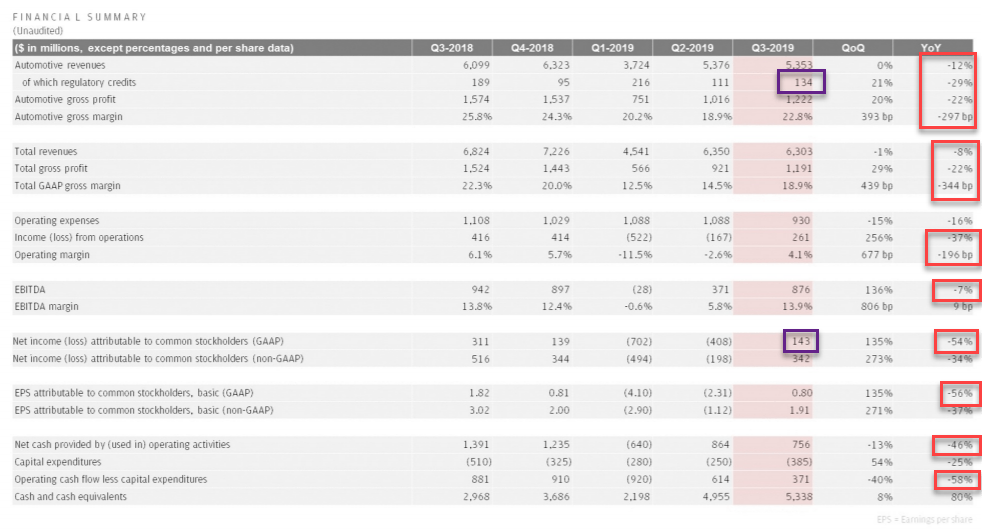
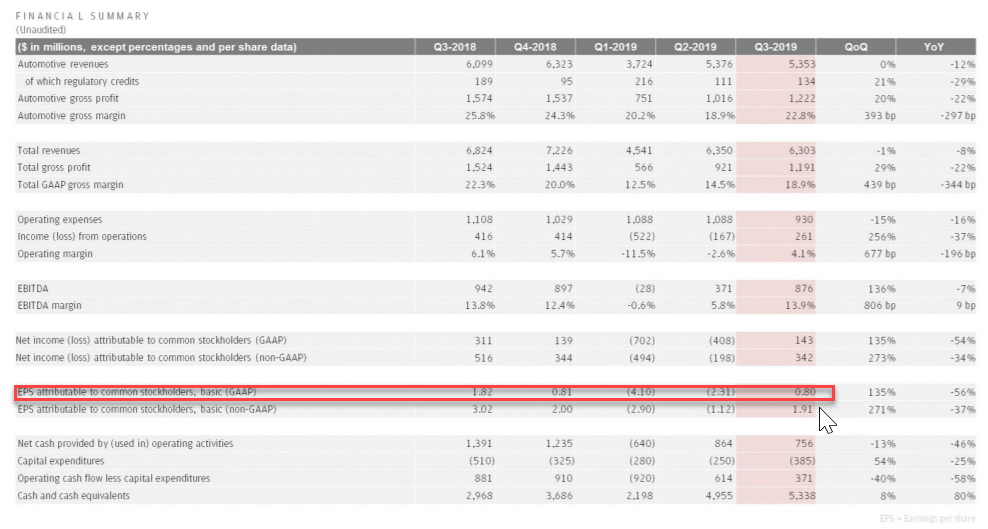
While the number of vehicles sold in Q3 increased, YoY revenues actually fell 12%, gross profit fell 22% and EPS fell 56%.
TSLA “adjusts” net income and EPS in “interesting” ways that do not reflect the true sustainable profitability of the company.
Reported cash flows include a significant share-based compensation component that is greater than the GAAP profit.
The company borrows money not only from its customers but also from its existing shareholders.
If you exclude regulatory credits of $134M, in Q3 the company made virtually no money.
I have solar panels and drove over 15K miles in last 12 months on electricity, most of it using adaptive cruise control. I am bullish on electric vehicles and self-driving. With that out of the way, I will explain to you why I am bearish on Tesla (TSLA) and how Elon Musk runs the company on money borrowed not only via debt, but also from its customers and even from its existing shareholders, while making virtually no money in the process.

Some Background

Tesla bulls base their thesis on equating electric vehicles, solar power and self-driving to Tesla. They project significant growth in those areas for Tesla as if they assume that competitors will merely concede the market to Tesla. Further, they assume Tesla has a technological lead in all of those areas. This is simply not the case. For a long time, Tesla and Solar City relied on Panasonic for solar panel and battery technology. I personally have a SunPower solar system, because it has a higher efficiency coefficient. While Panasonic panels are not far behind, they are also available from independent installers for a lower installed cost.
As for self-driving, GM and Google have the lead at this point. Finally, on the electric vehicle front, there will be an onslaught of competition from established players, especially starting in 2020, due to regulatory changes in Europe. For people like me, who won’t accept shoddy quality and cost-cutting masquerading as modern design, EVs from established players will fit the bill nicely.
To give Tesla and Musk credit, they have excellent electric motor tech, groundbreaking over the air software updates, the “coolness” factor, low advertising costs via random Tweets, can borrow money from its customers and existing shareholders. Unfortunately, the latter is something that helped build the company yet distorts the financial numbers that some people accept at face value. Let’s look at those numbers, in particular at the Q3 results that for some reason people see as positive.

Q3 Numbers

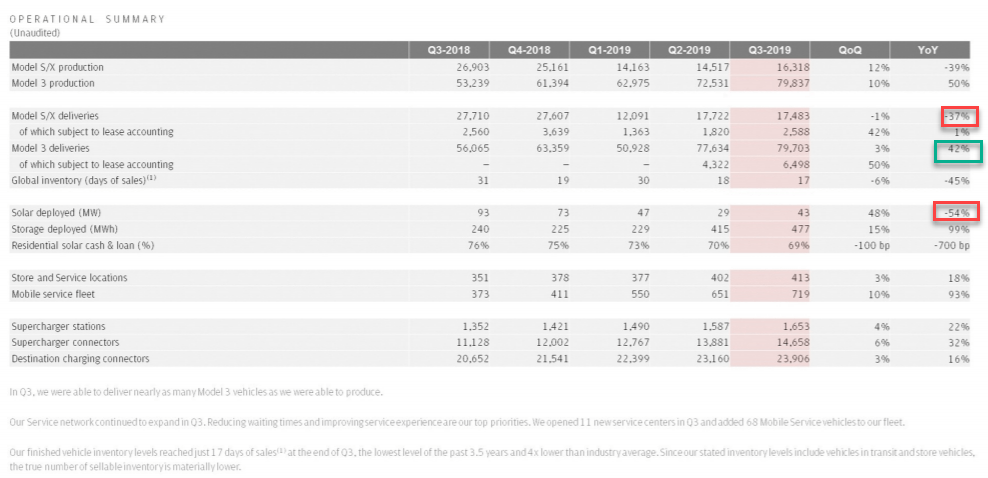
While we wait for the Form 10-Q to be filed, we have the TSLA Form 8-K to get the numbers from. We need to compare numbers YoY, to the Q3 2018 since there is seasonality to sales. Below you can see that sales of more lucrative models S and X are falling while Model 3 increased. Solar installs are falling too.
Source: TLSA Form 8-K
If we look at financials, the picture is troubling. Sales, margins and profits are all down significantly YoY. The only consolation is the numbers are better than the horrible Q1 and mediocre Q2. Also note, almost the entirety of net income is made by regulatory credits. In other words, without them the company made virtually no money.
Source: TLSA Form 8-K
In fact, this is the story of Tesla business model so far. Regulatory credits that contribute to both top and bottom lines as well as tax incentives that encourage people to pay more for Tesla’s products, since they will be getting some of the money back via tax credits. Now that the latter is being scaled down, Tesla has to absorb the difference.

Invisible Borrowing

While it is widely known that Tesla issued bonds, what is less understood is that they borrowed money from their own customers and event existing shareholders. The borrowing from customers is relatively straightforward: you can pay for vaguely-defined functionality that will be delivered later (if at all). The borrowing from existing shareholder is less obvious and is being spun as a positive by Tesla adding it back into its “Adjusted EPS” as well as into FCF.
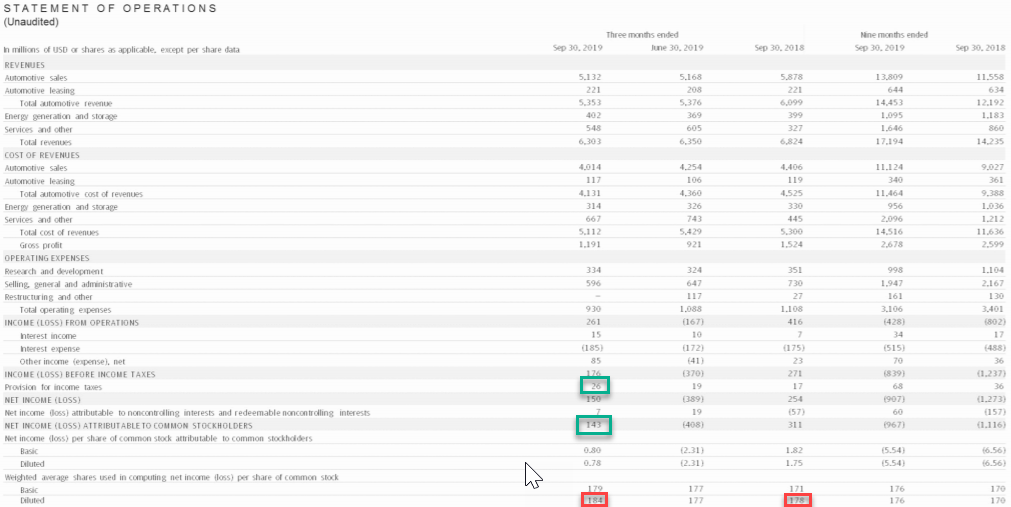
In one of his speeches, published in “Poor Charlie’s Almanac”, Charlie Munger presented a hypothetical company that switched some of their employee compensation from cash to stock. Share-based compensation is not free, especially if it is as impactful as at Tesla. In Q3, the SBC was $199M. For comparison, it was more than the net profit of the company. It is obvious that SBC is not “free”, it dilutes existing shareholders. In other words, it is logically no different than if Tesla issued additional shares, sold them and then used the proceeds for the actual cash compensation, in-kind. You can see the dilution, some of which is due to SBC:
Source: TLSA Form 8-K
You can see the dilution in the areas I highlighted. About 4% a year might not sound like much, but it adds up over time. Holding the same number of shares, over time you own smaller and smaller part of the company. Yet TSLA takes that money that they effectively borrowing from their own existing shareholders and pretend it was “free” while calculating “Adjusted EPS”.

Adjusted Net Income and EPS

While the Q3 GAAP net profit was $143M and diluted EPS was $0.78, the “adjusted net income” was provided as $342M and “adjusted EPS” was given as $1.91. This is just pure fiction. Usually, when companies provide “adjusted” net income and EPS, they exclude non-recurring items that do not reflect the true profitability of the company. They take GAAP numbers, then remove restructuring or similar costs, after tax. I have never seen companies add back SBC, until now.
As I demonstrated above, SBC has a real cost. If Tesla actually issued stock, sold it, and then used the proceeds to compensate its people instead of SBC, it would have to pay actual money. Assuming that money is $199M, the Q3 “adjusted” net income and EPS should be the same as GAAP numbers.

Free Cash Flow

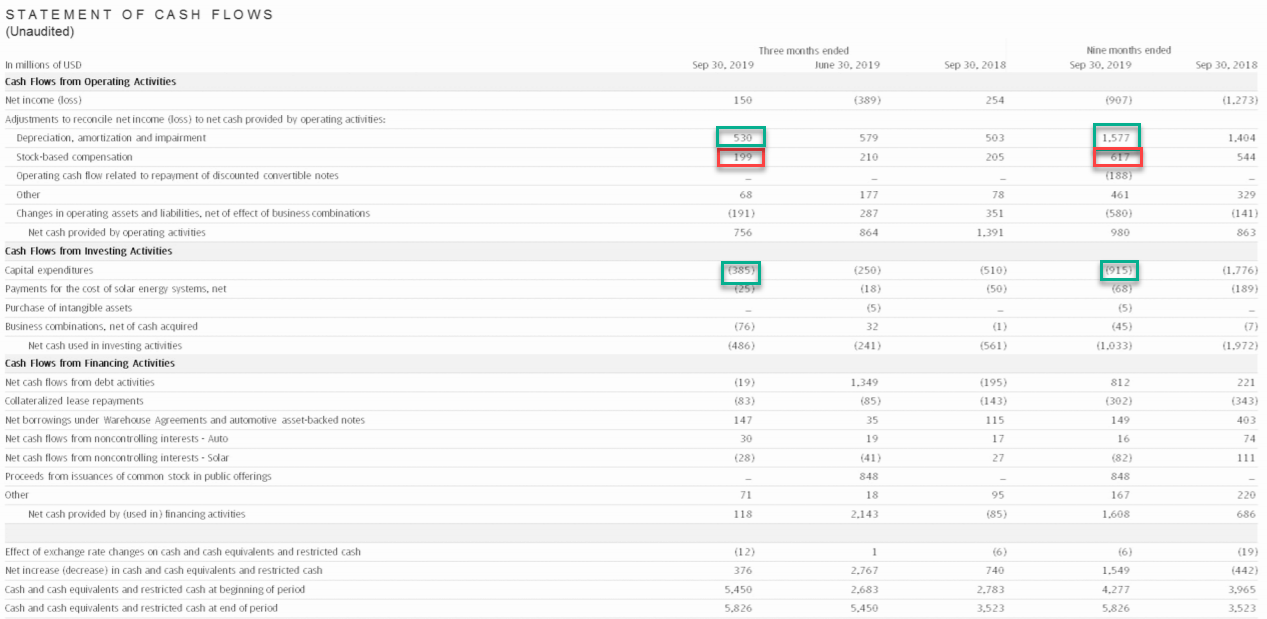
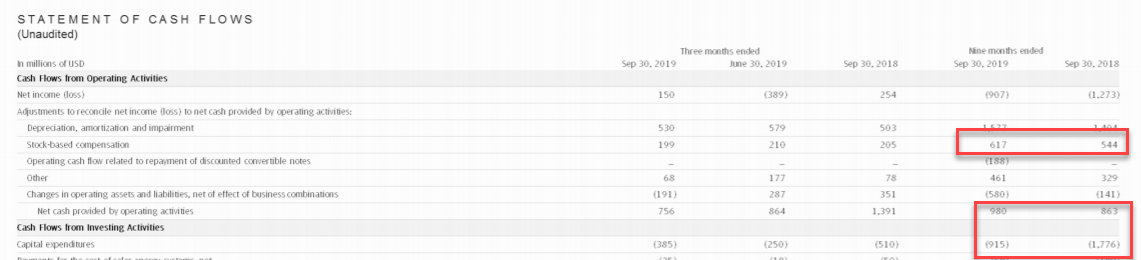
Similarly to the “adjusted” net income and EPS, FCF has SBC added back, which is correct since SBC was not nominally a cash cost. However, because the SBC at Tesla is so large in relation to FCF, it negates the benefit their FCF exhibits from the significant difference between the D&A and CapEx. For the 9 months, the D&A approximately matches CapEx plus SBC. SBC serves as a financial activity of borrowing from the existing shareholders.
Source: TLSA Form 8-K

CapEx

To be fair, Tesla’s CapEx includes a “growth” component and therefore the sustaining, or “maintenance” CapEx is likely lower. However, car manufacturers are generally CapEx-heavy. Still, the Tesla’s “normalized” FCF would be greater than GAAP net income, even if you take SBC into account. Therefore Tesla is indeed more profitable than what GAAP net income and EPS imply. The question is by how much and to what extent will this headwind is being compensated by regulatory credits, that are also large.

Historical Performance

Let's not forget that the company keeps losing money on TTM or FY basis. See the highlighted area below.
Source: TLSA Form 8-K
The FCF if you adjust it for SBC is sharply negative as well. For trailing 9 months it would have been 980-915-617= negative $552M. 
The numbers only look decent if you ignore SBC. In effect, existing shareholders give money to the company (via dilution) and then are positively surprised when that money appears in "adjusted EPS" and FCF numbers.

Bottom Line

Musk is a genius and Tesla has been a disruptor in many areas. In the current state, despite impressive “adjusted” numbers, in reality Tesla barely makes money. While I hope Tesla continues to be successful in contributing to electric vehicle and solar sales, I believe the current share prices are not justified by reasonable expectations. It remains to be seen if Tesla can achieve “escape velocity” at all, especially if there is a recession in near term. I am presently neither long nor short, but it will be interesting how the picture develops in 2020 when there is more competition and Tesla Model Y is released.
Disclosure: I/we have no positions in any stocks mentioned, but may initiate a short position in TSLA over the next 72 hours.

Friday, August 10, 2018

OhmConnect - Saving the Environment and Making Money In Process

Sadly I only discovered OhmConnect in May. And it turns out a couple of coworkers were using it for a while. I wish I knew about it sooner.

OhmConnect pays you not to use your electricity once in a while. I was skeptical at first, but got over $100 in July and on track to make even more in August. And for context, my electric bill in July was $85. So by not using electricity for 1-2 hours 2 times a week in July, not only did I offset my entire electric bill for the month, but was $15 ahead.

And I expect to make more in August. For example, I made $55 for two events (they call them Ohm Hour) in one week.

Check it out here: Ohm Connect (get $10 to start). You will get $10 also to get started.

Inaccurate Trip Computer in 2018 Honda Clarity Plug-In

While Honda got many things right with the 2018 Honda Clarity Plug-In, there are a few glaring mistakes. The first one is the trip computer (and the MPG display).

It seems it doesn't take into account the electricity use, so when I run on electricity alone, I get 199MPG displayed. And if the HV mode is used or the gas engine turns itself on, the MPG goes down but not nearly enough. It still shows numbers like 146 mpg. Only if you use the "trip" mpg readout and make sure to reset your trip meter (e.g. "trip A") one the engine fires up, do youget somewhat reasonable numbers, such as 40-50 MPG driving at steady 70 mph.

And the "distance to empty", which has the EV and HV part has a definitely wrong HV number. It should account only for gas and with the 7-gallon gas tank I expect to see a maximum of 7 gal x 60 mpg = 420 miles at the most optimistic estimate. But mine shows 716 miles right now, which would mean I would be getting 100 MPG running purely on gas. Madness.

Honda needs to fix this. It is completely unacceptable and is not rocket science.

Selecting a Trunk Liner for 2018 Honda Clarity Plug-In

A month ago I bought a 2018 Honda Clarity Plug-In Touring. Whenever I buy a car, I immediately buy a trunk liner to avoid grocery and other spills from becoming stains and smells.

There just was one problem this time. The factory/OEM trunk liner is expensive, at $100+, which is expected and not really a problem. But unlike the previous Honda liners I bought for a couple of different Accords, the trunk liner for Clarity is the same for all three variants: Hydrogen Fuel Cell model, Electric (BEV) and the Plug-in. And because the former two have bigger humps in the forward portion of the trunk (to hold the hydrogen tank or extra battery) than my plug-in, the liner is too small for my use. It covers only the rearmost portion of the trunk.

In order to cover the entire floor of the trunk, including the raised front portion, I needed a properly-sized liner. And seems nobody makes Clarity-specific liners. I checked the usual suspects, including WeatherTech. And in the end, I decided to get a universal liner and trim it as needed.

WeatherTech universal liner listed as fitting Clarity on their web site would have been too small. And it is pricey. So I got another liner from Amazon, which only required trimming the two corners with scissors, It is thick enough to be sturdy yet thin enough to protect the walls of the trunk a little. And it has spikes on the bottom to prevent the liner from sliding around. Here is the liner (click on it to view it on Amazon):

It did smell like oil for a few days, but now the smell has faded. Very happy overall. It doesn't slide and the cost was much lower than what I expected or was prepared to pay.

Thursday, November 12, 2015

Honda Accord or Mazda6?

We already have a 2014 Honda Accord EX-L and now need to get another vehicle to replace a 2006 Honda Accord VP. But there is a problem.

After doing much research and soul-searching, it got even worse. Note: we need memory seats, so I am comparing 2016 Honda Accord EX-L and Mazda 6 Grand Touring here. Lower trims have no memory seats.

The Mazda6 looks better, has slightly better fuel economy and acceleration, handles better and its 6-speed automatic transmission requires no maintenance and should be more reliable than the CVT. It is more fun to drive, the seats more comfortable and the interior looks nicer. The expected reliability is better. And it has blind spot monitoring and rear cross-traffic alert.

But Honda is cheaper, the visibility and rearview mirrors are better, the insurance rates are lower. The ride is better, there is less noise. The spark plugs need not replacement in 105K miles, whereas in Mazda it is 85K. And the oil change interval is flexible and has been close to 9K miles in our experience, whereas in Mazda it seems to be 7.5K.

Where it gets worse is in terms of safety, which is an area I find extremely important, as the last two Accords we had were totaled in accidents through other drivers' faults.

Mazda has a wide-angle rearview camera and blind spot monitoring with rear cross-traffic alert. Sounds nice, until you realize that the guidlines on the camera are fixed. Honda's wide angle rearview camera has dynamic guidelines, which simplify parking and other maneuvers substantially. And while there is no blind spot monitoring, it has LaneWatch: a camera in the right outside rear view mirror that shows you the whole blind spot when you have your right turn signal on. How useful is it? It sound superfluous at first blush, but since it has distance markings, I can clearly see if there is enough space for the car in the next lane and whether the car there is letting me in or being a jerk.

Crash test results are similar. And although in Mazda you can get autobrake feature that can stop the car as a part of the package that also includes iLoop energy recovery system and grille shutters, etc. for a couple thou, Honda has Honda Sensing that includes both low and high speed autobrake as well as dynamic adaptive cruise control for less than 1K.

So at the end of the day, I am afraid it will be the Accord. I hoped it would be Mazda. I like the way it looks, drives and the seat and overall ergonomics. And adaptive LED headlights are cool as is other tech, But the price is high and depreciation is worse as are the insurance rates. And the lack of dynamic guidelines in the rear view monitor is a deal-breaker.

Monday, July 27, 2015

Microsoft Lumia 640 Is a Major Improvement

After using the Nokia Lumia 520/521 and then Lumia 635, I got the Microsoft Lumia 640. It is a major improvement in many areas and I am shocked to see how good it is at a price several times lower than an iPhone or Samsung S6.

For starters, it supports LTE, came with T-Mobile's WiFi calling, supports VoLTE, has an excellent battery life, full 720p 5-inch screen, has both the front and the rear cameras, a flash for the main camera (8-Megapixel resolution), has a 4-core processor and 1 GB of RAM.

The phone has 8 GB of storage and supports MicroSD of any size ( I got the 32GB MicroSD). And all of this costs less than $100 now. Wow.

My T-Mobile phone came with Windows 8.1 Denim and Microsoft stated this phone would be among the first to get Windows 10. It feels solid and convenient in your hand despite its large 5-inch screen size.

It even came with 1 year of free Office 365 online, which is normally $70. Not that I am using the actual office part of it, but it gives you 1TB of cloud storage.

In Use

I have had the phone for about 4 months now and it has been super-stable and responsive. And although there is a lack of second-tier apps and some of the apps it has are unpolished comparing to the iOS/iPhone counterparts and although the Waze app for Windows Phone is no longer supported and keeps crashing, the Lumia 640 is still inexpensive and awesome.

Durability

I have dropped the phone several times and so did my wife. In each case, the phone developed small dents that do not affect the functionality. In a few instances the case opened and the battery fell out, but I put it all back together and all still works. Try this with your fragile iPhone!

Battery Life

The battery life is simply amazing. Easily enough for a full day of heavy use.

Friday, February 20, 2015

iHealth Align - Gluco-Monitoring System BG1 - junk

What a cool concept: use a small device that plugs into an iPhone and uses iPhone and a dedicated app to show you the results of your blood glucose tests, plot graphs over time, etc. Right?

So I thought when I got it to see how my blood glucose levels behave. The test strips for this device are cheaper than those of the OneTouch Ultra I was using prior.

Although the concept for this device is cool and the app for iOS is slick, there is a major problem with it. Namely, it just doesn't work.

Yes, the device is relatively easy to use and should be economical too, since strips are much cheaper than those of the OneTouch Ultra meters. And the app shows you all kinds of trends over time. And the lancing device is excellent and painless to use. But the results cannot be trusted.

I used the supplied strips and scanned the cap of the container with my iPhone. On the first (fasting) reading, the app said my glucose was 61. Odd and very low. On the post-meal test, it said my glucose was 75. I immediately retested with reliable OneTouch Ultra 2 and the real reading was 104, not 75. So either the iHealth Align or the strips for it are defective. Either way, it is inexcusable.

After 2 days, the customer support has not returned my emails. Then they did (on the 3rd day), asking for all kinds of information and serial numbers. After I supplied all the info they asked for, nothing. I inquired again. No response. Then, almost 2 months later, I got an email from them stating that the device and strips are in good working order and I might be using an incorrect testing site or maybe need to have my iPhone sleep for a while. What?

I tested one more time, just for fun, and got a reading of 36. Which means I am in coma now. Or their device is pure garbage. Speaking of garbage, this is where I deposited it and its strips.

A side note: how can they know the device and strips are in good working order?

Bottom Line

Do not rely on readings from this device, unless you test it first with the test solution (not supplied with the device). The only possible use I could see for this device is to check for trends and that is assuming it is accurate in terms of trending, e.g. under-reports glucose by certain percentage consistently. But it is not even accurate to that extent as my last reading of 36 shows. 

Do not spend money on this garbage. Get something that actually works.

Thursday, January 22, 2015

Can you trust Yelp?

My wife had a couple of C-sections, the first one with by doctor who had 5-star Yelp ratings and the next with a one rated a bit higher than 3 stars. But the results were opposite.

The first doctor, despite having to do so by law, never showed up to check up on my wife while she was recovering in the hospital. My wife was very weak and lost a lot of blood and the scar was large and unappealing.

The second doctor was highly regarded by the staff of the hospital. After the C-section he performed, my wife was able to [slowly] walk on the third day and didn't take any pain medications after the second day. He fixed the scar left by the second doctor. My wife had a lot more energy. And he checked on her daily while we were in the hospital recovering.

When we mentioned the first doctor by name to the staff of the hospital, they were surprised we chose that person. Yet, the Yelp ratings were reversed. How could this be?

After this experience, my wife wrote a couple of reviews on Yelp. A negative review for the first MD and the positive for the second. When I checked, I discovered that the first (negative) review was "filtered out" and did not count towards the overall score of that doctor. So she still has a perfect 5-star rating, even though the ratings on doctor-specific web sites are reversed and people in the hospital uniformly know the same.

I discovered similar occurences when I wrote negative reviews on Yelp for some businesses but not others. And as far as I recall, my positive reviews were all visible. Later I found out something else.

According to several business owners and people who handle Internet marketing for companies I talked to, Yelp has a "premium" service, whereby they call you and offer for a monthly fee to manage your standings. You make your own conclusions, but I will no longer use Yelp unless I have to. And if I have to, I will definitely pay attention to "filtered out" reviews accessible by clicking a link at the bottom of other review.

So what is the point of a site where you don't get a truthful picture? Fortunately Yelp has competitors.

Sunday, January 11, 2015

2007 Honda Civic LX - Despite Its MPG, I Was Disappointed

After my girlfriend's 2006 Honda Accord VP was totaled in an accident, there was a choice to make between the usual suspects: 2007 Camry, 2007 Honda Accord VP, Hyundai Sonata and others. On interesting option that I researched extensively was 2007 Honda Civic LX. For about the same price (currently) as the Accord, the smaller Civic LX provides better fuel economy, better rear impact protection, better stereo and a cool semi-new design.

I test-drove the 2007 Civic LX but in the end we went with 2007 Accord VP. This review is based on test-driving the 2007 Honda Civic LX as well as on the ownership experience of the 2007 and 2006 Accord VP. The ownership experience with the Accord is important from the standpoint of maintenance (e.g. Maintenance Minder) as well as understanding the i-VTEC used in both 2.4L Accord and the 1.8L Civic engines.

There were no significant changes to the Civic from the 2006 to 2007 model year as the current Civic generation is new. And although I prefer the look of the 2-door Civic Coupe, we concentrated on more practical 4-door sedan version. Unfortunately I was disappointed.

The 2007 Honda Civic LX, despite being small, is currently more expensive than either the Accord VP or Sonata (Accord currently sells for less and Sonata as well, making both of the Accord VP and Sonata 4-cylinder cheaper than a Civic LX. I consider A/C essential in CA and Civic DX does not have one).

I was quoted $16,700-16,600 for either the Accord VP or Civic LX from the same dealership. Although in the end we went with Accord VP for $16,400, the choice was not easy.

On paper, the Civic LX has a lot going for it. The size is smaller than Accord, but the Civic is not very small and certainly has enough interior space. The rear impact ratings are good (active head restraints) and the other crash test ratings are impressive. The car gets good mileage at 30/40 MPG city/highway, which is important in the long run with the current (and future) gas prices exceeding $3 per gallon.

The car should not be very expensive to insure and it has the Honda Maintenance Minder system, which tells you when to change oil and perform other maintenance tasks based on the way you drive, not on preset mileage or time. This should decrease the maintenance costs. Accord has this system as well and I am impressed with it.

The stereo on the Civic LX has MP3 playback, 4 speakers and more power than Accord VP. It was time for a test drive, because on paper the Civic LX seemed to be a perfect choice for the price: relatively powerful, yet fuel-sipping, nice-looking and feature-rich.

Features 

The Honda Civic in its current form was introduced for 2006 model year. The 2007 Honda Accord LX features air conditioning, power locks, mirrors and windows, remote keyless entry with security system, panic alarm, 4-cylinder 140-hp i-VTEC engine and (in AT-equipped trim) a 5-speed automatic transmission. The manual transmission-equipped cars have a 5-speed manual gearbox.

The Civic LX rides on 16 inch steel wheels with 205-mm tires (195-mm tires on 15-inch wheels for Accord VP). All Civics have ABS, front, side and head curtain airbags, active head restraints. The Maintenance Minder system that monitors the oil life and shows it to you in percents at a push of a button. It also tells you when you need to change oil and go for other service based on driving conditions.

The 4-cylinder Civics are rated to deliver 30 mpg city / 40 mpg highway with auto transmission, 30/38 with manual. The back seats fold to increase usable trunk space, the steering wheel tilts, telescopes and has standard cruise control buttons. The dashboard has a tachometer in the usual spot, but the digital speedometer, temperature and fuel gauges are close to the windshield. Funky, but I do not mind.

The car has a remote control that lets you lock and unlock doors, but, unlike Accord, not open the trunk (you have to use the key). The fuel door locks and is unlocked by a mechanical lever from the inside. The car has a locking glove box, sliding single-compartment front armrest (Accord has dual-compartment), a couple of storage consoles in front.

Unlike the Accord, the taillights are not long lasting and quick-illuminating LED. And they look OK in the 4-door, but much better in a 2-door car. The mirrors and door handles are body color, as opposed to black ones on Accord VP.

About the Car 

The car is roomy for its size with cool materials and good finish. The fabric seems durable and the controls are within easy reach. The driver seat has easy to use adjustments for height, recline and front-back adjustment. The seats are comfortable: more so than the seats of the 2000 Mitsubishi Galant (one of the cars I used to have) and even than my Infiniti G35. The driver seat has very good lateral support and is Euro-firm.

The controls and overall look of the cabin are better than accord with more titanium-look accents. But there is too many different textures and styles in side. Also, the car I drove had a very large irregular gap between two panel of the dash, which makes me wonder how it passed quality control. Not something I expect from Honda.

The Civic has an A/C that works very well and features air filtration. The trunk has a large opening and the rear seats fold. But you have to use the key or internal handle to open it since the key/remote has no button that lets you open the trunk.

The engine compartment is not as neatly organized as Accord’s, but the access to all fluids is easy enough. The gauges, ,however funky, work well and are very legible and controls are easy to use with good tactile feel. And for some strange reason I love the fact that at any time you can press the button that switches between the trip odometers a couple of times and see the remaining oil life in percents.

It says "100%" for the first 10% of oil life, 90% for 90-80% and so on. Once it reaches "15%", it is time to replace oil. The speed with which it declines depends on how the car is driven, which should reduce the trips to the dealership and the oil consumption. After all, motor oil is made of mineral oil, just as the gasoline.

The stereo has good sound quality, better than the 2006 Accord VP, but I discovered that the speakers of 2007 Accord VP sound virtually as good. For the record, the Accord VP has only 2 speakers, other models have more speakers. The Civic LX has 4.

Performance 

The car is relatively quiet and the road irregularities are felt rather than heard. The tire noise from the car does not reach the cabin and on the freeway you hear other car's tire noise rather than your car's.

The steering is well-weighted, requiring more effort than that of the Camry of Galant, which is a good thing. It is more sensitive off-center than either of the two. The brakes are easy to modulate and ABS is a welcome feature.

Civics are known, among other things, for good fuel economy. The 4-cylinder auto is rated 30/40 MPG. The little 1.8L engine uses i-VTEC, version that emphasises economy over power. It switches to an “economy” mode at low to moderate loads in the lower RPM range, where it adjusts the timing and lift of one of the two intake valves relative to the other to produce an effect of having a smaller-displacement engine. It is also combined with an electronic throttle control that opens the throttle more at the same time, reducing pumping losses.

The acceleration is very good for a 4-cylinder compact car, about the same as a 4-cylinder Accord.

Subjective Feelings 

I personally drive a 2004 Infiniti G35 and still enjoy my turn at the wheel of the Accord. Might sound strange, but I like the efficiency of Accord, its clear and bright gauges, its planted feel and comfortable seat. The Accord feels solid.

I expected similar feelings from the Civic and was disappointed. It is solid, has planted feel and communicative steering. But my main gripe is it is not as refined over bumps as the Accord (granted Accord is heavier) and, more importantly, the extremely sloped windshield of the Civic, combined with a deep dashboard makes me feel strange.

First of all, the thick A-pillars, even though they are supplemented by little triangular windows in front of the front doors, block the driver’s view more than they should have. More importantly, I am 5'11" and I still cannot see or figure out where the car’s nose ends. The sloped windshield and the deep dash distort my perception of the car’s size.

The visibility backward is pretty bad as well. The rear glass is small and is blocked further by rear seat headrests. All this made me quite uncomfortable. This, combined with the slightly messy-looking engine compartment and the price higher than Accord VP made me change my mind and get an Accord.

The Civic LX does have a good stereo with MP3 playback and an aux input. It is practical overall and its compact size might be a boon in an urban environment. But test drive it first to see if you like the dash and its sloped windshield.

Pros: Fuel efficient, comfortable, pretty fast, safe, good resale values, good enginnering
Cons: Poor backward visibility, price too high, strange dashboard layout, windshield slope

Bottom Line 

I like the Honda Civic overall, but only recommend it if you can adjust to its super-sloped windshield and the dash size and layout. 

This review was originally written by me in 2007

Canon PowerShot S5 IS Digital Camera

Originally written by me in 2007.

Mega-zoom cameras are fun. Before digital mega-zoom cameras were available, you would have to carry around a bunch of lenses and a camera body to be able to get to 10x magnification, but now you can get a digital camera with 10x optical zoom and over for less than $500 and frequently even for less than $300.

Having 10x or more optical zoom is fun. You can zoom in to magnify far-away objects while staying far from them. But not all mega-zoom cameras are created equal. Some cameras have no image stabilization at all, resulting in blurry images at high magnification levels and/or in dim light. Some cameras rely on increased sensitivity setting (ISO) to increase the shutter speed thereby reducing blur caused by the shake when the camera is handheld.

At the top of the mega-zoom hierarchy are cameras with optically-stabilized zooms. These cameras move an optical element within the lens (some shift the CCD sensor itself) to reduce or eliminate blur caused by shooting handheld. The Canon PowerShot S5 IS is on of these cameras.

I have used many mega-zoom cameras, including the Panasonic Lumix DMC-FZ8, the Panasonic FZ7, the Canon PowerShot S3 IS, the Fuju S6000fd, the S700 and others.

The mega-zoom cameras are the most fun to use cameras for me. I wanted to try the new Canon PowerShot S5 IS. I bought the Canon S5 IS and after using it and comparing it to other stabilized-zoom cameras, I sold it on eBay (just as the previous Canon S-series models). Although the S5 IS is a good camera overall, it has its shortcomings, especially apparent after using the Panasonic FZ8 and the Fuji S6000fd, which is my current mega-zoom camera of choice.

An Improvement Over the Canon S3 IS? 

A replacement for the last year's popular Canon PowerShot S3 IS, the Canon PowerShot S5 IS is a digital camera with optical image stabilization, 12x zoom, 8-Megapixel resolution vs. 6MP, 2.5-inch LCD vs. 2-inch. The camera has face detection and features improved DIGIC III.

Just as the S3 IS, the S5 IS has an articulated LCD screen, uses 4 AA batteries and stores photos on SD memory cards. But it adds ISO 1600 mode.

The monster 12x optical zoom and optical image stabilization work together to give you sharp pictures when shooting handheld and/or at long distances. Only a handful of digital cameras have 12x optical zoom and even less have optical image stabilization that makes 12x optical zoom usable without introducing blurriness when shooting handheld.

The Canon S3 IS was an impressive and very popular camera. The only things I did not like about it were its use of 4 AA batteries, the fact that the filter adaptors were sold separately, whereas Panasonic FZ cameras came with them and the flimsy lens cap, as well as the fact that the flash had to be raised manually (unlike Panasonic cameras where you could just push a button).

The S5 has a hot shoe adapter for external flashes, moving it closer to semi-pro category.

The S5 has not improved in the areas I criticized (ever since S2 IS), but did improve in the area of resolution, LCD size, ISO range. Overall, the changes are evolutionary rather than revolutionary and are similar to changes that were introduced when Canon switched from the S2 IS to S3 IS.

About Canon PowerShot S5 IS 

The Canon S5 IS is a 8-Megapixel digital camera with 12x optical zoom (36-432mm in 35-mm equivalent), optical image stabilization with maximum apertures of f/2.7 at wide angle and f/3.5 at full telephoto. It stores images on an SD card in JPEG format.

The camera is only available in black color. It has a 2.5-inch fully-articulated LCD screen. The camera is relatively compact and feels solid, features USB 2.0 connectivity that is fast.

The 12x optical zoom optics features ultra-low dispersion (UD) lens and ultrasonic motor (USM) for fast and silent zooming. In addition to digital still photographs, the camera can record video clips with stereo sound. You can output video and sound to your TV (be it your pictures or video clips) using the supplied audio/video cable.

Features 

The S5 IS lets you shoot at the resolutions of up to 8 Megapixels and lets you print enlargements or crop the part of the picture and print it with excellent results. And, of course, it is more than enough for the standard 6x4 prints.

The camera features selectable ISO between 80, 100, 200, 400, 800 and 1600 as well as Auto and High ISO Auto. It also has manual focus (with focus bracketing) in addition to automatic 1-spot focus (the focus spot in auto mode can be moved to any position on the screen by using [SET] and arrow buttons).

The camera has an autofocus assist light for better and faster focusing in low-light conditions. It works well in dim light.

Metering and Exposure 

The exposure modes include Program AE, Aperture and Shutter Priority mode, and even full Manual mode. The shutter speed can be set between 15 and 1/3,200 sec with speeds slower than 1.3 sec available in Shutter Priority or Manual mode and operating with noise reduction.

The light metering can be selected between Evaluative, Center-Weighted and Spot (center or AF point). I find Spot and Center-Weighted modes useful when taking pictures of people at distances where the flash doesn't reach in backlight. In Evaluative metering mode, the faces might turn out underexposed, unless you dial some exposure compensation.

In Spot mode, you can set metering to properly expose the face. Also, the Spot metering mode can help you figure out the proper exposure in difficult lighting conditions be metering off the object with known tonal characteristics and then dialing some exposure compensation. The camera even has a live histogram.

Movie Mode 

The camera has a built-in stereo microphone for recording sounds while filming video clips and a speaker, which can be used for operational sounds or to play back the sounds recorded. The camera can record AVI movie clips at up to 640x480 pixels at 30 or 15 fps with stereo sound.

Focusing 

The camera has a Macro mode as well as Super Macro mode, in which it can focus as close as 0 inches. That's right - zero inches!

Focus Range: 

Normal: 50 cm (1.6 ft.) - infinity (W)/ 90 cm (3.0 ft.) - infinity (T)
Macro: 10 - 50 cm (3.9 in. to 1.6 ft.)
Super Macro: 0 - 10 cm ( 0 to 3.9 in.)

LCD and Viewfinder 

The camera has a fully articulated 2.5-inch LCD with 207,000 pixels that covers 100% of the view. The LCD requires quite a lot of force to flip outward or rotate, but feels sturdy as a result.

In addition to the LCD, there is an electronic viewfinder (EVF). Since it is difficult (and expensive) to make a 12x zooming optical viewfinder and impossible to easily confirm focus in a non-SLR optical viewfinder, the Canon S5 IS has an EVF.

Both the LCD and EVF are fluid, has pleasing colors and good resolution. Both are fluid, even in low light.

I found that the LCD is well-visible in regular conditions, but in sunlight, visibility decreases and you have to use the EVF, which works well in sunlight. The EVF by default is slightly dim.

Power

The power is supplied by 4 AA-sized batteries. Canon includes four alkaline batteries with the camera, but obviously you have to get your rechargeable batteries, preferably NiMH of high capacity and a charger if you plan to use the camera at all as the alkaline batteries that are included don't last long and cannot be recharged. I have used 4 Rayovac 2300 mAh NiMH batteries.

I personally dislike cameras that don't come with rechargeable batteries, unless they are inexpensive. The advantage of using AA batteries is the ease of finding replacement rechargeable or disposable batteries. Also, if you use high-capacity rechargeable NiMH batteries, you can get 450 shots out of the S5 (according to Canon, in reality the number is lower), comparing to about 300 shots I used to get from my Panasonic FZ5 on one battery charge.

The disadvantage is the price of batteries and the charger, the weight and inconvenience of having to deal with 4 batteries instead of one. The S5 IS was already heavier than the Panasonic FZ5 or FZ7 and got even heavier when batteries were loaded. It is also more expensive without the batteries than the FZ8 with its rechargeable battery and a charger.

One thing to note: the camera comes preset to continuous focus and continuous image stabilization, both of which are battery hogs. I recommend that you disable both of them (and switch to focusing and OIS only after the shutter release button is depressed), unless you like and have an opportunity to recharge your batteries often.

On Resolution 

The difference between 6MP and 8MP is minimal. For majority of people who only print 6x4 or 5x7 photos and do not crop, there is no difference at all.

Operation 

After my camera arrived (I bought it for $434), I found it to be well built and have a solid feel. The camera has a SLR-style body and is relatively convenient to hold. Upon arrival, I loaded my four 2300 mAh Rayovac NiMH batteries in the camera, inserted my 512 MB SD card (although the S5 IS comes with a 32-MB SD card, it is too small to be usable) and was ready to shoot.

In the Box 

The camera comes with 4 AA-sized disposable batteries, a neck strap, a stereo video cable, USB cable, a lens cap, a 32-MB SD memory card, CD-ROM and manuals.

Performance 

The camera's operation is fast. The power-up takes less than 2 seconds (mostly taken by the lens extension) and is relatively quiet. The camera focuses very fast as well (under a second), seemingly as fast as the Panasonic FZ7.

The zooming is the most impressive aspect of this camera. It is precise and can be very fast (although slightly noisier than the FZ7's). The S5 IS has variable speed zoom (2 speeds) with faster speed being very fast - you can zoom from wide to full telephoto in about a second. Viva Canon USM (ultra-sonic motor)! And the slower speed lets you fine-tune the composition precisely.

The shutter lag when pre-focused is virtually absent and the picture is taken almost instantaneously. The shot-to-shot delay is a bit more than one second. In high-speed shooting modes, the images were captured at about 2 fps.

Shooting with flash is slower since the flash needs time to recharge. I was surprised to see that the flash recycle time can reach 8s seconds (shooting indoors at f/7.1. At least the screen did not go blank in the meantime, unlike some 2-AA battery equipped Canons of the A-line.

The flash has red-eye reduction modes, which still don't eliminate the red eye completely. No worries - I can fix that in Photoshop.

Battery Life

The image stabilization has several modes: Off, Continuous, Shoot Only, Panning. The camera comes with mode set to Continuous by default, which is a battery hog.

I haven't used the continuous image stabilization as it reduces battery life and, more importantly, produces slightly more motion blur in images in comparison to the image stabilization during the shutter release only. I got good pictures, but still not so good battery life.

I was able to take more than 170 pictures without seeing the low-battery warning.

Manual Focus

I liked the manual focus ability. When focusing manually, you see the focus area enlarged to help you fine-tune your focus and you also see the distance markings. Truth be told, I find manual focus rarely needed as the automatic focus works really well.

Focusing 

The camera focuses fast, even in dim light and even at full telephoto. It had no issues in any light indoors.

Picture Quality 

When friends ask me for camera recommendations without being able to specify the exact usage criteria, I catch myself thinking (and frequently recommending) Canon cameras. One of the reasons is the fact that they (at least currently) simply do not have poorly-designed cameras. Other manufacturers have better (in my opinion) cameras in some specific areas. But as far as the overall lineup goes, Canon cannot be beat.

One of the outcomes of this is the uniformly excellent picture quality of Canon cameras. True, some of them (e.g. small SD-series cameras) have slightly blurry corners. But overall, Canon cameras have uniformly excellent colors, good sharpness and produce images that look good printed.

The S5 IS is no exception. It produces excellent pictures, even though some of them were slightly overexposed for my taste. They are richly saturated, sharp from wide angle to telephoto and have pleasing colors. I really like the sky colors and the way the camera renders clouds.

The image stabilization worked well and let me take handheld photos at full telephoto at 1/100 and sometimes at slower speeds. I also could take handheld photos at 1/10 (and slower) at wide angle. This is much better than the rule of the recommended handheld shutter speeds (1/equivalent focal length) suggests. Without image stabilization I wouldn't be able to take pictures at the above shutter speeds. 1/500 at telephoto and 1/50 at wide angle would be the slowest I could use.

I mostly used the lowest ISO available (ISO 80) and saw no noise. At higher ISO settings, the noise starts to appear. At ISO 200, you can see noise appear in the shadows/darker areas and ISO 400 has quite detectable noise, the ISO 800 features even worse noise, which becomes rather bad and the detail level suffers too. Fortunately, you can avoid having to use it in most situations by simply using a slower shutter speed and/or larger apertures (e.g. F2.7 at wide angle). Image stabilization lets you use those slower speeds handheld without fear of motion blur appearing on your pictures.

But if you have to have a faster shutter speed, then you have to use ISO 400-1,600. Surprisingly, the noise at ISO 800 is not as bad as I expected and ISO 800 photos can be printed at 4x6 size. You can print ISO 1,600 pictures, but I would only recommend it in situations where you have no other choice.

The lens of the S5 exhibits very slight barrel distortion and no noticeable pincushion distortion at telephoto. There is chromatic aberration (CA) to be found in high-contrast scenes, especially at the telephoto end of the zoom. This is despite the UD element in the lens. As is usually the case with mega-zoom cameras, the telephoto shots have slightly soft corners, but nothing major.

Ease of Use

Once you get used to Canon menu systems, they are pretty easy to use. Overall, the eaqse of use is very high and almost reaches my all-time favorite (Panasonic).s

Computer Connectivity

The USB cable that comes with the camera has a label that states that you have to install the software first before attempting to connect the camera to your computer. This is in the worst tradition of Canon - I never had to install any software with my Panasonic cameras.

The USB 2.0 on this Canon is a "real" USB 2.0 High Speed however - the transfer speeds are fast. I also used my memory card reader.

Face Detection 

Just as many other recent cameras, the S5 IS features face detection technology. The face detection works surprisingly well, finding faces in the frame, showing you that it found them by displaying focusing rectangles over them, focusing on them and making sure they are focused on. I played with it (I just had to) and discovered that you can defeat it by covering an eye or covering the mouth. Overall, I feel it is a useful technology and a cool one too.

Warranty 

The camera comes with 1-year parts and 90-day labor warranty.

So Is It An Improvement Over The S3 IS? 

Although the S5 IS improves on the S3 in some areas (resolution, LCD size, ISO 1,600, face detection), it is still pretty much the same camera. This is not a bad thing. The Canon PowerShot S3 IS was an excellent camera in many respects. You have to decide if slightly larger LCD, higher resolution, face detection and usable ISO 1,600 are worth the difference in price.

Competition 

You can get the Panasonic Lumix DMC-FZ8 with 12x optical stabilized zoom by Leica, 7.2MP resolution and battery pack with charger and other accessories for much less (under $290 currently). For my money, I would prefer the FZ8 to the S5. Saving over $100 is never a bad thing.

In any case, I am sticking with my current mega-zoom camera: Fuji S6000fd. It is quite a different camera, but I like it more.

Pros: Build quality, resolution, picture quality, fast 12x zoom with optical stabilization, large LCD
Cons: Expensive, no RAW, uses 4 AA batteries

Bottom Line 

The Canon PowerShot S5 IS is an excellent choice if you need a camera with 12x optical zoom and optical image stabilization. But you can save by getting the Panasonic Lumix DMC-FZ8: it is an excellent and inexpensive camera. And you will not have to deal with 4 AA batteries..

Thursday, January 8, 2015

Invicta Automatic 8926A Pro Diver Wrist Watch

The Invicta Pro Diver 8926 is an automatic (mechanical self-winding) waterproof watch. It has a Japanese mechanism. I bought mine over 8.5 years ago for less than $100 to use for swimming or car-washing, but soon discovered that it has many positive qualities that make me wear it most of the time. In the beginning however, I did not expect too much from the Invicta Pro Diver 8926A .

I have also owned a Japanese Orient 3-star automatic watch, which I have been very happy with for over 13 years. This gives me a point of reference.

Whereas the original Invicta Pro Diver 8926 had coin edge bezel design and was a look-alike of the Rolex Submariner, Invicta changed the bezel design later (there are rumors that it was due to a lawsuit) to look less like Rolex. The new model became Invicta Pro Diver 8926A.

Now, there are several submodels of the Invicta Pro Diver 8926 with letters at the end of the model number indicating the bezel design. The new 8926C has the coin edge bezel, similar to the Rolex Submariner.


What is Invicta 8926

The Invicta Pro Diver 8926 is an automatic wristwatch and is one of the many Rolex Submariner look-alike watches. The 8926 has a Japanese 21-jewel mechanical automatic movement (self-wound by the movement of your hand). The movement is Myota and is made by Citizen. It is not one of the prettiest movements to look at, but it works pretty well.

The case of the watch is made of stainless steel and it has a see-through window on the back. You cans see the movement through it. It is interesting to watch.

The 8926 is a diver-style watch with 200m (600ft) water resistance. The watch has three hands: hour, minute and second. It also displays the date (the day of the month, but not the day of the week) with a magnifier (what Rolex calls "Cyclops").

Having gotten used to my Orient, I wish this Invicta also had the day of the week display. And in fact, it could, since the movement itself supports the day of the week display. But the makers choose not to include this functionality, probably to stay with the Rolex look, and simplicity.

The watch's bezel rotates in one direction. The bracelet is heavy-duty stainless-steel design with solid links, polished middle section (the rest is brushed stainless steel) and diver buckle with a safety clasp.

Mechanical vs. Quartz

After wearing automatic (mechanical) watches for the last 13 years, I doubt I will ever want to wear a quartz watch. There are people who think that mechanical watches are the way of the past. I read someone who stated that mechanical watches are going the way of manual transmissions in cars. This is true. Most people prefer automatic transmissions (at least in the US). But I love to drive a manual, even though it is a hassle in heavy. And I love mechanical watches because they do not consist of the quartz crystal and a bunch of transistors. I love mechanical watches because they need good design and craftsmanship to be accurate and reliable.

There will always be positive and negative aspects of anything. Quartz watches, aside from the vast minority that is charged by the movement of your hand, need replacement batteries. Automatic mechanical watches do not, but they need to be services once in a while. How often? I have not serviced my Orient in 13 years and not going to until it stops ticking.

Yes, mechanical watches stop if you don't wear or wind them, and quartz watches do not. I wear a watch every day, so this is not an issue for me.

Performance

The watch arrived in a bright-yellow Invicta box. The box contained the manual and is very nice by itself. The watch itself was a complete surprise however. The watch is heavy. It and its bracelet are very solid. It is difficult to imagine that it sells for less than $100.

The bracelet is very heavy-duty. Fitting to my wrist required removing two links. The bracelet has polished center links and brushed outer links, which gives it an upscale appearance, but also makes it more susceptible to scratches being visible in the middle (polished) section.

The watch has been pretty accurate so far (for a mechanical watch, that is). It gains approximately 3 minutes per month. Whereas anybody can make an accurate quartz watch, an accurate mechanical watche requires much higher precision. The Myota movement by Citizen is known to be reliable and accurate.

This Invicta utilizes a screw-in crown to make the watch water-resistant up to 200m. This allows you dive while wearing it. In addition to winding the watch by wearing it, you can also wind the watch manually - a feature not frequently found on automatic watches. The crown operation is solid and precise, but the screw-in/out action requires a lot of force.

The watch's movement is non-hacking, which means the second hand does not stop when the crown is pulled. This means you cannot synchronize the watch (e.g. to the atomic clock) precisely, but it does not matter much since the watch's level of accuracy is not very high. What is the use of synchronizing to a second, when you know the watch will be ahead by 20 or so seconds in a day.

The watch's automatic winding is unidirectional, which is less effective than Seiko or Orient designs. For instance, Seiko Magic Wheel design winds the watch in both directions. But the Myota's unideirectional winding works well enough and the watch seems to keep the energy for more than 30 hours.

I find the watch's unidirectional bezel a bit stiff and requiring a little too much force to rotate, but it gives it a more solid feel.

The watch's both front and back have mineral crystal glass. I dislike the front magnification window for the date. Although most watches of the Rolex Submariner style use it, I find it to be unnecessary and making the styling of the watch less clean.

The Trinite coating on the hands and the hour markings as well as on the bezel is much brighter than my Orient's, but slightly dimmer than Seikos or expensive Swiss brands. It is very bright for about 2 hours, but there is still some residual glow at up to 8-9 hours.

I actually have never used the watch while swimming. But I discovered that not only this is my preferred watch for car washing and other water-related activities, but I like to wear this watch to work and pretty much every day. I am still wearing my Orient periodically, if only to keep it running (it has no manual winding), but my standards for a watch are now higher.

Durability

I have had this watch for 7.5 years and it works flawlessly so far.

Pros: Good automatic movement, low price, solid and good-looking, 200m water resistance, bright Trinite coating
Cons: Not the most accurate, no day of week display, not a well-known name


Bottom Line

The Invicta Pro Diver 8926 is an excellent buy if you want a diver auto-winding mechanical watch. This is a real nice-looking diver watch with tank-like stainless steel construction, solid bracelet links and good performance for less than $100. I highly recommend it.

Wednesday, December 24, 2014

Nokia Lumia 635 vs. Lumia 520/521 and 530

Having used the Nokia Lumia 521 phones for about 10 months, I was ready for a change. While the phone worked ok, it was a bit slow to respond to command, especially after the Windows 8.1 update. Plus I know that it didn't support 4G LTE and the battery life was a bit too short.

The phone was otherwise solid. We have had 3 of them in our family and they worked well for 10 months, even though I dropped mine several times and we are constantly spending time at the beach where the sand gets into phones all the time.

The Lumia 521 is a T-Mobile version of Lumia 520. We were using them on the T-Mobile network. This model is now being replaced by a cheaper Lumia 530, which is worse than the older 520/521 in a few ways. It also has a 4-inch screen. Although it is faster, it has no dedicated camera button, no autofocus in the camera, no light sensor and worse display colors. It still doesn't support 4G LTE. That's quite a few "no"s.

My 521 already had the Windows 8.1 update with Cortana, etc so no improvement was expected there.

Nokia Lumia 635

Lumia 635 on the other hand is an improvement on the 520/521 in almost every way. And this is why I now bought it for myself.

Feel

The new phone feels better in your hand, Buttons on its side have better tactile response. And navigational buttons that are now located on the screen rather than below it are somehow easier to use.

Screen

It has a larger 4.5-inch IPS LCD screen with 480x854 resolution. While the pixel density is still pretty low at 221 ppi (better phones have 300+), the screen is much better than that of the 530/520/521, because it has Nokia's ClearBlack technology, which makes colors more vibrant and contrast better.

4G LTE Speed

Unlike the 520/521/530 Lumias, the 635 supports full 4G LTE speeds. "LTE" is displayed in the upper-left corner when in LTE reception area. And in conjunction with the 4-core processor (520/521 had two cores), it transforms web browsing experience.

Speed

The Nokia 635 is very responsive, unlike the 520/521. I saw benchmarks that measured its speed at over double that of the 520, but even subjectively it is very noticeable.

Camera

The dedicated camera button is gone, but unlike 530, the autofocus remains. And pictures look a little better than both 520/521 and 530. There is still no flash and no front-facing camera, so no selfies or Skype video calls.

Battery Life

In short, it is noticeably better.

iPhone 5 and iOS 8

Interestingly, the my Nokia 635 with Windows 8.1 and Cortana is better than the iPhone 5 (with iOS 8 on it) in a few key areas of performance. It has better WiFi reception when far away from the WiFi router, better text scaling and better internet video playback quality. That is in addition to being several times cheaper and using a standard USB cable for charging and no need to install iTunes bloatware.

Bottom Line

I like my new Lumia 635 much better than the 521. The major differences include a larger, more vibrant screen at 4.5 inches vs 4 inches on the 521, longer battery life, faster 4G connectivity, more responsive operation through the faster 4-core Snapdragon 400. While it still has some of the shortcomings of the 521, such as a lack of flash or front-facing camera and even a new one: the dedicated shutter release button for the camera is gone.

Still, it was a great upgrade and I am happy with it, especially since it was less than $100. It will not rival any iPhones when it comes to most features, but the iPhones are $400-600 more. And Android phones are more vulnerable to viruses, so I am not even considering those.

Wednesday, December 3, 2014

Using Google Chromecast from Windows Phone

We have 3 Windows Phone devices, in addition to an iOS, Android and Kindle Fire devices. And it is more convenient to control the Google Chromecast from the phone.

Unlike the iOS (iPhone), Android and Kindle tablets, which allow me to watch Youtube videos and other content on the TV using Chromecast, there is no official support of the Chromecast on Windows Phone devices. So our Windows 8.1 phones were not useful when it came to Chromecast. Plus the Youtube app from the Windows Store is merely a wrapper around the mobile version of the Youtube web site. Poor navigation and video quality is the result.

Then I discovered Tubecast. TubeCast is an app that is available in Windows Store and not only has much better interface and video quality that the aforementioned "official" Youtube app, it lets you cast videos to ChromeCast too! The app version I got was free and the first 20 casts were free too. Then I had to pay a couple of bucks. Nice.

The only issue for me now is when I got a Chromecast for my mother and went to install it, I didn't bring any devices other than my (and her) WP. Plus she has a Windows 8.1 computer. The problem is during initial installation, the phone complained that Chrome browser was needed and the computer installed the Chromecast app and then indicated that WiFi connection was needed. The computer in question uses Ethernet wired connection to the WiFi router. So I will need to bring either an iOS or Android device to complete the setup.

Otherwise, WP 8.1 can now be used to control the Youtube playback on Chromecast. Nice.

Friday, October 24, 2014

Panasonic BQ-CC17SBA eneloop AA/AAA Advanced Individual Battery Charger

I needed a new charger for AA and AAA NiMH batteries I use in my son't toys. I used a Rayovac PS1 charger over a decade. It charges batteries individually and seemingly somewhat smartly, but it is slow and inconvenient. Plus at times you need to remove and reinsert a battery a few times.

The solution was Panasonic BQ-CC17SBA that is a smart charger that can charge up to 4 AA or AAA batteries individually, in any combination. It uses 150 mA current to charge AAA and 300 mA to charge AA, so it should have been faster than the Rayovac PS1 (uses 200 mA) for AA batteries. It is also allegedly smart and designed to be used with eneloop LSD (low self-discharge) batteries.


While it works well and is a pleasure to use, while not taking much space, it has a significant (for me) problem. Even though it is designed to recharge eneloop and eneloop pro batteries, it should chanrge regular Panasonic and other NiMH batteries. And this is where it failed me.

eneloop AAA charged perfectly, But Rayovac AA NiMH batteries I have used for many years and can still recharge fine in the Raoyovac PS1 charger did not charge at all. The LED lights would blink and no charging would happen.

Non-eneloop Panasonic batteries charge fine.

Instead of going through the hassle of returning the charger and getting something more expensive, I plan on using it for batteries other than Raoyovac and charge those in the PS1 charger.

Saturday, September 13, 2014

Some "grass-fed" beef probably isn't

I have been buying grass-fed beef for several years now. The reasons were few: health benefits through better Omega-3 content, CLA (conjugated linoleic acid), more vitamins, better treatment of animals. And the game-y, beefy flavor.

The problem is when I bought grass-fed beef from the local California Hearst Ranch and from Trader Joe's (New Zealand grass-fed beef), the beef had visibly little fat marbling and had that distinctive gamy (wild game-like) flavor, but when I bought so-called grass-fed beef at some other retailers, the flavor was the same as the regular, corn/whatever-junk-they-can-find-fed beef. In some cases, there also was suspiciously too much fat in the meat.

Examples:

  • Costco used to sell packs of grass-fed organic beef sourced from Uruguay. The beef didn't taste grass-fed, was tough and chewey.
  • So-called grass-fed beef bought at Ralphs had a lot of fat streaks and didn't taste grass-fed, despite being allegedly grass-fed, organic and locally raised in California.
  • In some other instances, beef called grass-fed didn't taste as such
What does it mean? I will reserve judgement, but I will not buy these products as I trust my tongue and eyes more than I trust the labels. Not sure who, if anyone, checks if the beef claimed to be grass-fed is actually is. I will keep looking for and buying beef that tastes grass-fed.


Friday, September 5, 2014

2008 Infiniti G35 Sport Sedan - Inexpensive and Sporty

The Infiniti dealership I go to for service is nice enough to provide loners with any service other than fast ones (e.g. oil change). When my 2004 Infiniti G35 Sedan was almost 5 years old and had quite a few warranty-related issues and recalls and currently required services like coolant change and brake service, I got to drive Infiniti loners quite a lot.

Over the ownership period of my G35, I drove G35s of different model years and equipment levels as well as the FX35. Currently, I am driving the new 2008 Infiniti G35. I drove a 2007 model before and was impressed with changes and improvements over the previous generations, but not quite enough to make a switch. The 2008 model is very similar to the 2007 one, but with a couple of improvements.

I will go over the car's features and performance as well as the improvements over the last year's model/models and the ownership/maintenance experience with 2004 model, which is relevant to both 2004 and 2007 models (you will see why). I would like to mention here that although I like the 2008 G35 and the current incentives make its price very low, there will be new Infiniti G37 sedan hitting dealerships somewhere around September. It will include bigger engine from the current G37 coupe and, most likely, 7-speed automatic transmission as well as self-healing paint. I am anxious to drive that model.

More Info 

The 2008 Infiniti G35 Sedan is a rear-wheel drive car with a 3.5-liter V6 engine, which produces 306 horsepower and 270 lb-ft of torque (with either a 5-speed automatic or 6-speed manual transmission). The power in the model I got (Journey) is routed through the 5-speed automatic transmission to the rear wheels. Also available are an AWD version (G35x) as well as a rear wheel drive model with a 6-speed manual transmission (G35S).

The new 3.5-liter V6 engine is improved over the VQ35DE of the 2003-2006 models, including the rev-up version of thereof, which was installed on 6-speed 2005-2006 models and featured more power through the use of variable exhaust timing in addition to the standard variable intake timing. Some rev-up engines sadly developed appetite for motor oil (excessive oil consumption problems), although this is not entirely relevant to the discussion of the 2008 G35.

The new engine, VQ35HR, is more rigid, features better cooling, longer connecting rods for less friction/lateral forces, iridium-tipped spark plugs, dual intakes with individual throttles and air filter elements as well as dual exhaust with equal-length headers. The 306 hp (SAE) is achieved even disregarding the ram air effect that, according to Infiniti, adds extra 3 hp at 60 mph.

The car features 52/48 weight distribution front to rear and has aluminum suspension components. The standard-issue G35 has zero-lift front aerodynamics and feels very stable at high speeds. It also features LED stoplights, which illuminate faster and last longer than conventional lights.

The front features HID bi-xenon headlights. The brakes have electronic force distribution, ABS, vehicle dynamic control and brake assist. The G35 has front, side and head-curtain airbags as well as active head restraints (they move forward in rear-end collisions helping to prevent whiplash). It got great crash-test ratings in both front and side impacts.

You can get more information elsewhere, but I just have to say that I believe that the G35 is a great bargain: the interior space of a BMW 528 with more power for the price of the stripped BMW 328. Of course, there are other variables involved, even aside from the BMW's legendary handling and free maintenance. And then there is the new twin-turbo 335i with over 300 hp and lots of torque. But then, the BMWs are also legendary for their use of super-expensive (to replace) run-flat tires and not-so-stellar reliability.

Regardless, the car I am currently driving is the 2008 Infiniti G35 Sedan Journey. Journey models include Dual-Zone Automatic Temperature Control. All G35 models include tons of features, including Power Windows, locks, Intelligent Key with keyless entry and pushbutton ignition, etc.

Pricing 

The review was originally written in mid-2008, Although usually the G35 costs slightly over $30K in real-world prices for the very well-equipped base G35, you can currently get one for less than $29K. This is most likely due to housing/economy-induced car sales declines, gas prices and the fact that the new 2009 models are just around the corner.

The Journey adds dual-zone climate control and replaces the CD player with a 6-CD changer for less than $500. G35x has four-wheel drive and the G35S comes with 6-speed manual. Instead of the last year’s G35S Auto you now have to order G35 Journey with Sport Package (auto has magnesium paddle shifters and will have G35’s sport seats, bigger wheels and tires and front spoiler). Sadly, you still cannot get sport seats, etc. combined with wood interior and/or Journey’s front spoiler (I like it better than G35S’s).

Fully-loaded G35 with premium package, navigation, rear-view camera and 4-wheel steering can still be bought for well under $40K (street price currently; no taxes or fees included in numbers herein).

Improvements Over the 2007 Model 

There are a handful of improvements over the 2007 G35: available iPod integration, driver soundstage feature of the Bose Studio On Wheels and minor refinements.

Improvements Over the 2003-2006 Models 

Comparing with the previous generation, I noticed improvements immediately. The exterior looks much more sporty and stylish and more modern. The interior features significantly better materials and easier-to-use controls, including the screen. The buttons and controls seem to have better feel.

The gauges and displays don't seem to suffer from backlight as much as they do in my 2004 model. The strange orange backlight is gone and is replaced by more conventional red/blue/white illumination scheme. The steering wheel has better leather cover with seams that no longer under your fingers.

The seats have better shape and seemingly slightly better leather. The armrests on doors and center are soft and leather (or leatherette) covered. This is unlike my 2004 G35, which has plastic that tries (but not nearly hard enough) to look like leather.

I like the intelligent key feature. You do not have to remove the key from your pocket, just push the button to unlock the car and push the button in the dash to start the engine.

The car seems to be quieter in the engine noise at low revs and the noise under full throttle is more refined.

The car I am currently driving has Goodyear Eagle RS-A tires as opposed to my car's Bridgestone Turanza EL42 (which I gladly replaced with much better Yokohama YK520 before they wore out, so terrible they were). The steering feels more precise but there seems to be more tire noise.

The interior uses real aluminum trim and, unlike 2003-2006 models I have driven, this particular car has no rattles. I prefer wood interiors, but this particular aluminum trim uses interesting texture inspired by washi paper. I like it better than the pattern on the BMW X3s I have driven a while ago.

Brakes 

The brakes are a little disappointing. They are squishy, whereas I enjoyed 2003-2004-style grabby brake pads more. The brakes have been redesigned for 2005 to deal with excessive wear and I have not liked them since, not in this 2008 model either. Maybe the ones on the G35S are better.

I have read a lot of complaints about 2003 and 2004 models brakes that would wear out rather quickly, sometimes supposedly by 10,000 miles. My 2004 model wore them out in 15K (and I don't tailgate, even in heavy traffic and use lower gears going downhill in the mountains), but Infiniti recognized the problem and offered free brake service for 2003 and 2004 models up to 3 years or 36,000 miles.

To avoid these issues, the newer models have longer-lasting pad with less initial bite. I dislike them. And they still squeal occasionally, especially in cold weather. The 2008 model is no exception. It is practical to have longer-lasting brakes and they do work very well when the force is applied. But if you want better-feeling brakes, try the sport package.

Engine Compartment 

I like to do some of the maintenance myself. The older models were a PITA in this respect: engine lid used a prop rod, the oil dipstick has more bends and twists than a politician’s answer to a direct question, the air filter replacement required removal of the air intake pipe.

The new G35 is much better. The hood uses gas-filled struts, the dipstick is in front and easy to use, the dual air filters are replaceable in 2 minutes. And the engine cover no longer looks like a Batman's chest plate.

The new engine pulls very well. The old VQ35DE would seem to run out of breath as it approached the redline, probably due to the restrictive single intake and exhaust. The WOT sound was a, quite mechanical, angry growl. It is a bit unrefined but I still like it.

The new one does not run out of breath and keeps pulling in linear fashion up to redline, all while making awesome sounds - refined yet powerful.

Interior 

The car is roomy inside and I find the seat very comfortable, due in part to the adjustable lumbar support. There is plenty of leg room up front and in the back seat. The wheel tilts together with the instrument cluster. The Premium Package gives you the power tilting/telescoping and the wheel automatically moves up when the door is open to ease getting out.

The car has a dual automatic climate control, which is easy to use. The audio control buttons on the steering wheel make it easy to control the CD playback or radio without even looking. The steering wheel is convenient and has buttons for cruise control as well as for audio control functions. The back seat does not fold, but has a pass-through with an arm rest for the back passengers, which doubles as the cup holders.

Intelligent Key 

The Intelligent Key itself looks like an egg-shaped remote control. It has buttons to lock/unlock doors, lock the trunk or sound panic alarm.

You can lock/unlock the car or unlock the trunk by pushing buttons on the remote. Alternatively, you can unlock the trunk by pushing a button on the rear of the car, while having the IK in your pocket. In the same manner you can lock/unlock the front doors by pushing a small black button on the outside door handle (the car will beep).

I have discovered the small annoyance here. If the car is locked and you push this button on the passenger side first, the passenger door unlocks (but not the driver's door). If you then push the button on the driver's side, instead of unlocking it, all locks will become locked.

Exterior 

The standard 17-inch aluminum wheels look nice and are fitted with 225mm V-rated Goodyear Eagle RS-A tires (the sports package equipped cars get W-rated tires in 225mm front, 245mm rears on 18-inch wheels).

The outside power heated mirrors can be folded (manually). I love the new exterior styling, but it makes rearward visibility from the driver's seat somewhat worse than before.

Trunk 

The trunk is relatively roomy and has a cargo net. The opening is quite large and the trunk lid has gas-filled struts. The trunk can be opened from the cabin or by pressing a button on the remote. The trunk lid has a handle on the inside to close the lid without having to touch the outside (possibly dirty) surface, as well as the glowing-in-the-dark release handle.

Handling 

My 2004 G35 handles really well, but the tires (Bridgestone Turanza EL42) were disappointing and it doesn't handle as a BMW 3 series I drove in BMW performance driving school.

The 2008 model with Goodyear Eagle RS-A tires seems to handle better (maybe due to the tires and better steering) but I keep the Vehicle Dynamic Control (VDC) on, even though there is an off switch because the car still can lift-throttle-oversteers.

The new G35 does feel solid and more planted than the older models. It also (in non-sport trim) has reasonably compliant suspension. And it corners and brakes quite flat. But it still feels a bit heavy and the brakes require too much effort, which inspires no confidence.

Brakes 

As described above, the brakes are now less sensitive (comparing to the 2003-2004 models) and easier to modulate and are supposed to last longer.

Transmission 

The 5-speed automatic transmission shifts smoothly and does not hesitate to downshift. The shifts seem to be even smoother on 2008 model than on 2005, perhaps the engine now matches the revs better/faster. The G35's transmission works well enough in the full auto mode. Plus, the car is available with the 6-speed manual transmission.

The manual shifting is available as well. You choose the gear, not the range of gears. The car even shifts to 1st gear once you come to a stop. The shifting is pretty fast and the car matches revs almost instantaneously - a feature that was handy in the mountains.

Another benefit of the updated transmission is the car provides more engine braking and it, together with the better engine, improves fuel economy. I averaged 25 MPG in mixed city/freeway driving whereas in my 2004 G35 I can never get over 24 MPG, even in all-freeway driving. The instant-MPG readout in the instrument cluster probably helps here too.

Maintenance 

Unlike BMW, Mercedes, Volvo or Audi, which provide you with free scheduled maintenance for 3-4 years, you have to pay for your maintenance with Infiniti. BMW and Mercedes cars have flexible service system which tells you when to change the oil (10K-15K miles).

The G35 has 3 service schedules, with driving in ideal conditions requiring oil changes every 7,500 miles. Two other schedules - preferred (for people who are paranoid or have OCD) and severe (for all others) - require oil changes every 3,750 miles.

The manual explicitly states that Infiniti recommends mineral-based oils. Based on experience with my 2004 models, the maintenance costs at the dealership are pretty high. Although I can pay $21 for oil changes at my dealership since I bought car here (regular price is $50), I paid $130 for 7.5K mile service, which included only oil change, tire rotation and a couple of inspections. This is not counting the annual (or 15K miles, whichever comes first) in-cabin air filter replacement that dealerships normally want about $100 for.

Worse, I was quoted almost $500 for 15K maintenance, which included an oil change, tire rotation and some inspections. After I asked to have service elements itemized, the service advisor agreed to perform the 15K service for $170. Still a rip-off, but at least I got a loner car.

Do It Yourself (a.k.a. DIY) 

I do some maintenance items myself. Replacing the in-cabin microfilter normally costs $80-120, but you can do it yourself for about $30 (price of the filter). You have to remove the glove box, but it is doable.

Some items require less maintenance than in other cars. The new iridium-tipped spark plugs need replacement every 105K. The engine uses long-lasting timing chain rather than timing belt, which would need replacement every 60-100 K.

The engine air filters are now easy to replace. One gripe I have is - why can't Infiniti develop a system similar to Honda's Maintenance Minder? Even GM has oil life monitors that tell you when to change oil based on how you drive. I have to stick with the conservative 3,750-mile interval instead (I like to employ Wide Open Throttle technique sometimes). This is probably the shortest oil change interval of all manufacturers, which is not good for me or the planet.

Even Lexus does not ask you to change oil as often, let alone Volvo or Audi even with their turbocharged engines. If Infiniti positions itself as a luxury vehicle manufacturer, do they not consider the time of their target client segment valuable? Using a good synthetic oil would not only allow them extent the oil change interval, but would also improve the cold engine startup wear somewhat. I just don't understand why they don't do this.

Fuel 

The manual recommends Premium 91-octane, but permits operation on Regular 87 if you have to. But I am sure you don't. Buying a 30K+ car with over 300 hp only to try to save a few bucks at a price of performance is just silly. Plus you might not save much money, if any. Using lower-octane gas reduces performance and fuel economy.

The fuel tank holds 20 gallons. I averaged 25 mpg in mixed city/highway driving, which is much better than the 22-23 MPG I average in my 2004 G35 in the same kind of driving.

Safety 

The car was crash-tested and got the best (GOOD) rating in the frontal and side crash tests. The previous generation of G35 had the lowest driver fatality rate among sedans, the same as BMW 7-series and second only to Chevy Astro minivan. The G35 had 11 fatalities for each 1 million vehicle-miles, same as the BMW 7-series. For comparison, Volvo S40 was somewhere in 40-60 range, Honda Accord and VW Passat in 30-40, similar to Volvo S60, BMW 3 and 5 and Mercedes C and E.

Not Good 

There is nothing terrible with the new G35, it is just not as much improvement as I expected. The new handsome look inside and out is appreciable at a first sight, but it is still no Lexus or Acura.

The leather is no match for Lexus or Acura hides. The dash uses plastic that looks better than the old G35, but still no match for the above two. The engine start/stop button on Lexus models looks much better.

The trip computer buttons were sticking as I was using them. The tire roar seems to be worse than in the previous generation, but this should mostly depend on the tire model and on how worn the tires are.

The steering is definitely better in both feel and precision, but steering assist changes very drastically with speed and it gets a little scary if you turn while slowing down dramatically and also because of the way the steering wheel obtains a life of its own when you enter roads with different grip under left and right sides of the car.

The value content, which has always been the G35's strong characteristic is higher than ever. The other players from Acura, Lexus, BWM, Audi or Mercedes are pricier. And new BMW and Mercedes models do not inspire me from the interior or exterior design perspective.

But there are things that seem to have been missed. Why do I still have to change oil every 3,750 miles? Why does my mother's Honda Accord have a flexible oil life (and overall maintenance) monitor while being 50% of the price of the G35? Why do I have to pay extra for Premium package to get the ability to open all 4 windows remotely, whereas the cheapest base 2007 Honda Accord VP (that's Value Package, folks), purchased for $16.4K provided this feature?

Could Infiniti spend a few extra bucks on better materials and wheel arch insulation? Why still 5-speed auto, whereas most others use 6-7 speeds? Why introduce VVEL on a G37 coupe and not on the G35?

These are rhetorical questions, of course. And some of them will hopefully be answered with the 2009 G37 7-speed auto.

When I remind myself about how much power the 2008 G35 has, how little it costs, its features, its controls' ease of use, its engine sound, ease of maintenance, its beautiful exterior and much improved interior, I stop thinking about negatives.

The 2008 G35 is an evolutionary step and a good one. A significant improvement on the previous generation with some flaws left over. Let's hope Infiniti eliminates most of them by the time I part with my 2004 G35. Otherwise it might be a used Porsche in my future.

The 2009 model has the VVEL-equipped 328hp 3.7-liter V6 (the same as in 2008 G37 coupe), 7-speed auto, self-healing paint, slightly improved interior, new [ugly] wheel design for the Sport package and more refinements. I wish it had cooled seats and significantly improved fuel economy. But the 7-speed transmission and VVEL help with the MPG and acceleration.

Pros: Price, features, excellent engine, acceleration, handling, looks, seats, safety
Cons: Rear seats do not fold, tire noise, no vented seats, maintenance intervals

Bottom Line 

The improved 2008 G35 is a good car and I highly recommend it for the price. Just make sure you are OK with less than stellar fuel economy and check the car for rattles before buying. If you can pay a little more though, go for the 2009 G37.